> For the complete documentation index, see [llms.txt](https://docs.jdmindicators.com/llms.txt). Markdown versions of documentation pages are available by appending `.md` to page URLs; this page is available as [Markdown](https://docs.jdmindicators.com/strategy/strategy-settings/trade-settings.md).
# Trade Settings
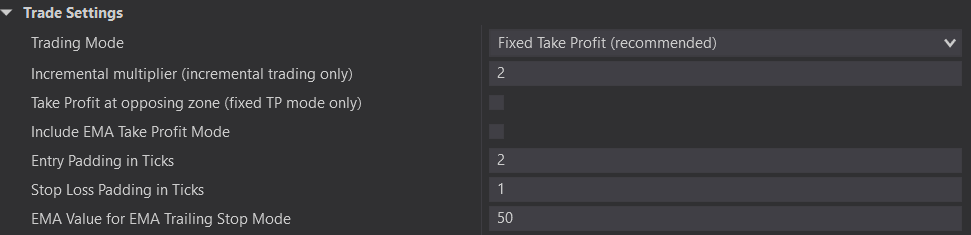
These settings controls which automated trading mode you wish you use
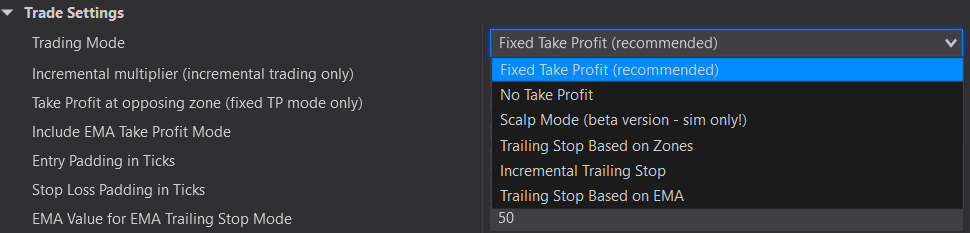
## **Trading Mode**
Offers various modes for automated trading
* **Fixed take profit**
* This does not use a trailing stop at all and will always trade with a fixed take profit, based on your risk management settings
* **Profit Target (see Risk Management section)**
* Automatic Position Sizing Mode
* The fixed take profit will automatically be calculated based on your risk settings
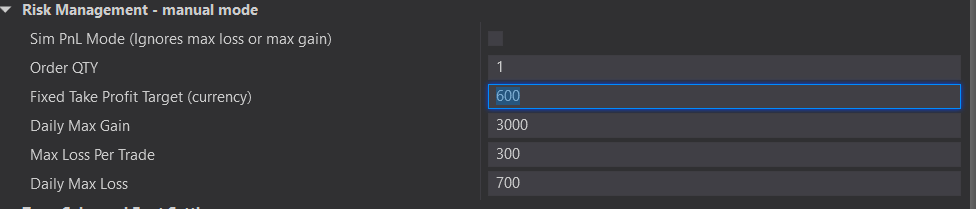
* Risk Management - Manual Mode
* The value entered in the Fixed Take Profit (currency) field is the amount in currency you want for your take profit.
* The order qty is factored into where this profit target order is placed
* **Scalp Mode (currently in beta)**
* **Trailing Stop Based on Zones**
* This is a very powerful way of trading and is the recommended way to trade if you are using a trailing stop
* The stop will not move until a new zone is formed.
* The stop will be placed at the low of the new demand zone or high of the new supply zone
* For example, if you are going long on a demand zone and price starts moving upwards, the stop will remain in place until a new demand zone is formed above your current filled market position. The stop will then move below the low of the new demand zone, locking in gains and moving to a safe position that is less likely to result in you being stopped out, as zones act as support and resistance areas in this situation.
* The opposite example will occur when going short and the stop will move down only when new supply zone is formed below your current filled market position
* **Incremental Trailing Stop**
* This will not use any take profit and will trail the current price based on an incremental value
* The incremental value is the amount the price needs to move in currency before the stop will move. Based on the risk of the zone (e.g $200 zone risk) means the stop will move in $200 increments.
* Trailing Stop Incremental Multiplier will allow you to set the distance the stop will maintain always between the current price.
* For example, if you set the multiplier to 4 and the zone risk amount is $200, this means that the stop will not start moving until price has reached at least $800 gap (multiplier of 4 times zone risk of $200), between the stop. The stop will increment down by the zone risk amount ($200, always maintaining a distance of $800 between the current price.
* Trailing Stop Based on EMA
***
## **Incremental Multiplier (incremental trading only)**
* This will not use any take profit and will trail the current price based on an incremental value
* The incremental value is the amount the price needs to move in currency before the stop will move. Based on the risk of the zone (e.g $200 zone risk) means the stop will move in $200 increments.
* Trailing Stop Incremental Multiplier will allow you to set the distance the stop will maintain always between the current price.
* For example, if you set the multiplier to 4 and the zone risk amount is $200, this means that the stop will not start moving until price has reached at least $800 gap (multiplier of 4 times zone risk of $200), between the stop. The stop will increment down by the zone risk amount ($200, always maintaining a distance of $800 between the current price.
***
## **Take profit at opposing zone (recommended way to trade fixed take profit)**
* This is a very powerful way to trade and will intelligently place the the take profit at the nearest opposing zone to your trade.
* For example, if you took a trade on a demand zone, you are going long. When your entry is filled at the demand zone, your take profit will be placed at the nearest supply zone, above the current price.
***
## **Include EMA Take Profit Mode**
* This mode will automatically close long positions that close above the EMA line and have a minimum amount of profit and then close back below the EMA line. You can enable this mode to any trading mode.
***
## **Entry Padding in Ticks**
* Value is in ticks
* This setting controls the amount in ticks that you wish to have your order entry price set at above a demand zone or below a supply zone
***
## **Stop Loss Padding in Ticks**
* Value is in ticks
* This setting controls the amount in ticks that you wish to have your stop loss price set at below a demand zone or above a supply zone